

In recent years, the sales of pure electric vehicles have grown rapidly. In addition to fuel savings, the main reason is the environment, and electric vehicles are becoming a more economical option than conventional cars, as they can be at least cheaper to operate and maintain, they do not emit pollutants through the exhaust pipe, and produce fewer greenhouse gases than new (and old) gasoline cars.
Electric vehicles can be charged through a charging station using a single cable that has two connectors, one for the vehicle socket and the other for the charging station, which is similar to charging a mobile phone. When choosing an electric vehicle, how do you go about choosing an electric vehicle connector?
AC charging connector
Slow (fast) EV charging stations are common for short-distance commuting, slow or fast charging at night is suitable for daily commuting, these charging stations use AC power and take several hours to charge the vehicle, and they are often used by EV owners for charging at night. Fast charging is ideal for long-distance travel, and both AC slow/fast charging and DC fast charging for electric vehicles have unique connectors.
The following EV charging connectors are options for AC fast charging:
Type1 Connector(J1772/IEC60309)
Type 2 connector (Mennekes/IEC62196)
GB/T type connector
The Type 1 connector is commonly used for EV charging in the United States and Japan, and it uses five pins without a locking mechanism. It uses electricity from a single-phase AC source to charge an electric vehicle. EV charging is typically rated at 3.7 or 7 kW and can charge the vehicle for 20 or 40 km/h. The connector is a 15V socket and the AC frequency depends on the region. The color of the cable indicates the output voltage, yellow for 100-130V for 50-60Hz AC, blue for 200-250V, and red for 380-480V. Typically, assembly takes place outdoors and the fittings are weather-resistant to IP44 standards.
Type 2 connectors are commonly used in the EU and India for AC charging of electric vehicles. They have seven prongs and a locking mechanism to charge the vehicle using single-phase or three-phase alternating current. Single-phase AC charging is rated at 3.7 and 7 kW and has a charging range of 20 and 40 kilometers per hour. Three-phase charging is rated at 22 kW and can be charged at speeds of up to 120 kilometers per hour. The charging unit has 7 pins, including 3 phase wires, 2 signal pins, 1 ground pin, and 1 neutral pin.
The GB/T connectors are mainly used in China and feature a seven-prong design with integrated locking. They offer two charging options with outputs of 250V and 440V for a maximum power output of 27.7 kW.
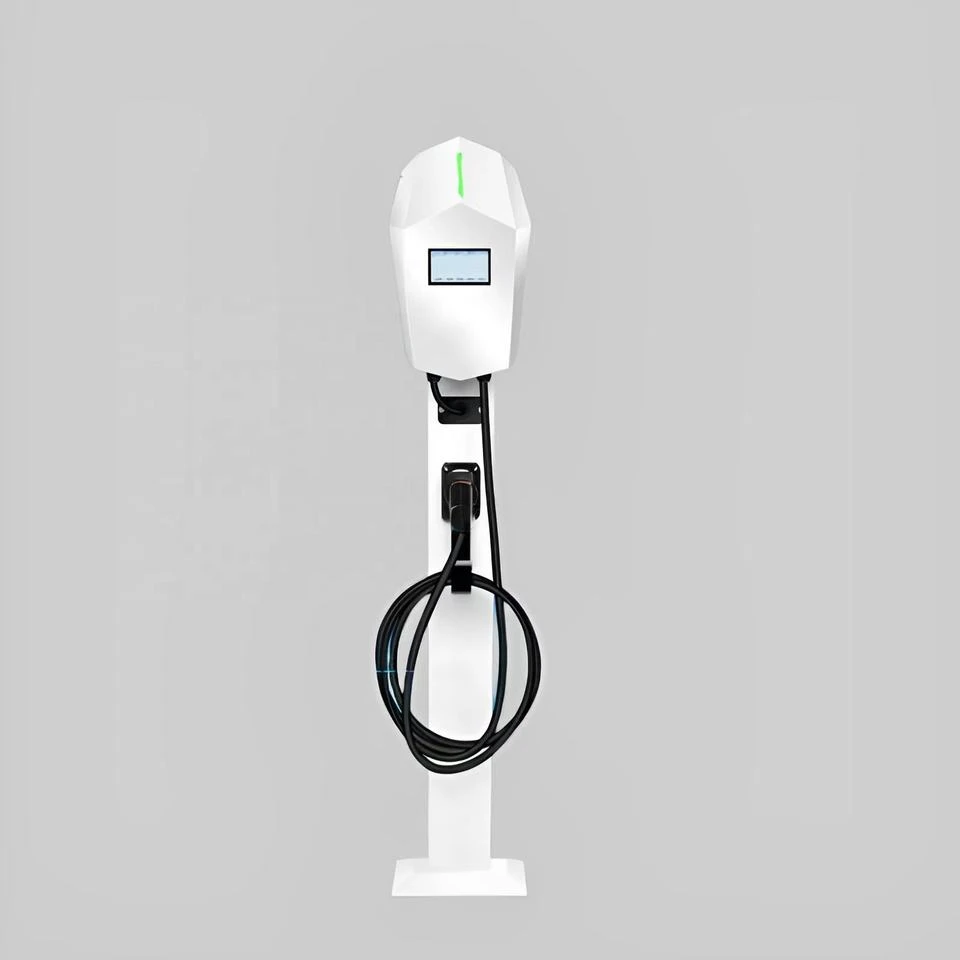
DC charging connector
The following EV charging connectors are options for AC fast charging:
CHAdeMO
Combined Charging System (CCS)
GB/T
The CHAdeMO DC connector was developed by Tepco, a Japanese utility company, and is mainly used in Japan. It has a 125A socket that can provide 50 and 100 kilowatts of power, allowing charging at 120 and 240 kilometers per hour.
CCS is the fast-charging standard used in the European Union. It uses a J1772 connector but has two extra pins for faster charging. These extra pins are arranged in Type 2. The connector is capable of providing different power rates to the charging vehicle, ranging from 50 kW to 350 kW, depending on the required charging speed. CCS1 is the North American standard plug type, and CCS2 is the EU standard plug type. Despite this difference, both plugs have the same DC pin structure and communication protocol. CCS connectors use PLCs to facilitate communication between electric vehicles and charging stations.
GB/T connectors are mainly used for DC fast charging in China, with an output voltage of 750/1000V and a rated current of 80-250A. The maximum power output capacity is 250 kW.
Recommendation: Do not use a three-pin plug
Why is it not recommended to use three-pin household plugs to charge electric vehicles? because they cannot output more than 10Wh of power, lack of two-way communication, are not weather-resistant, and have limitations. They are intended for indoor use only.