

1.Introduction to the OCPP Protocol
Open Charge Point Protocol (OCPP), developed by the Open Charge Alliance (OCA) based in the Netherlands, is a freely available protocol designed for standardized communication between Charging Stations (CS) and any Charge Point Management System (CPMS). This protocol architecture facilitates seamless communication management between central management systems of any charging service provider and all charging points, primarily addressing the various challenges arising from communication between private charging networks. OCPP enables seamless communication management between charging stations and central management systems of various providers. Over the past several years, the closed nature of private charging networks has caused considerable frustration for numerous electric vehicle owners and property managers, prompting widespread calls for an open model within the industry. The advantages of the OCPP protocol include open and free usage, prevention of vendor lock-in (charging platform), reduction in integration time/workload, and IT issues.

A.Introduction to the Development of OCPP Versions
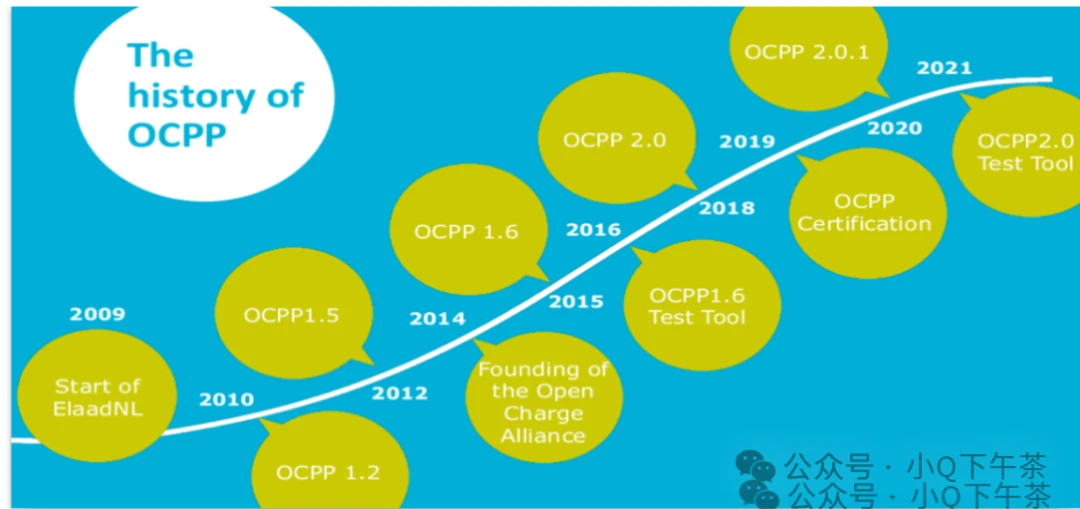
In 2009, the Dutch company ElaadNL initiated the formation of the Open Charge Alliance (OCA), primarily responsible for advancing the Open Charge Point Protocol (OCPP) and the Open Smart Charging Protocol (OSCP). These protocols are now owned by OCA. OCPP can support all types of charging technologies.
B.Introduction to OCPP Versions
OCPP Version Evolution: From OCPP 1.5 to the Latest OCPP 2.0.1
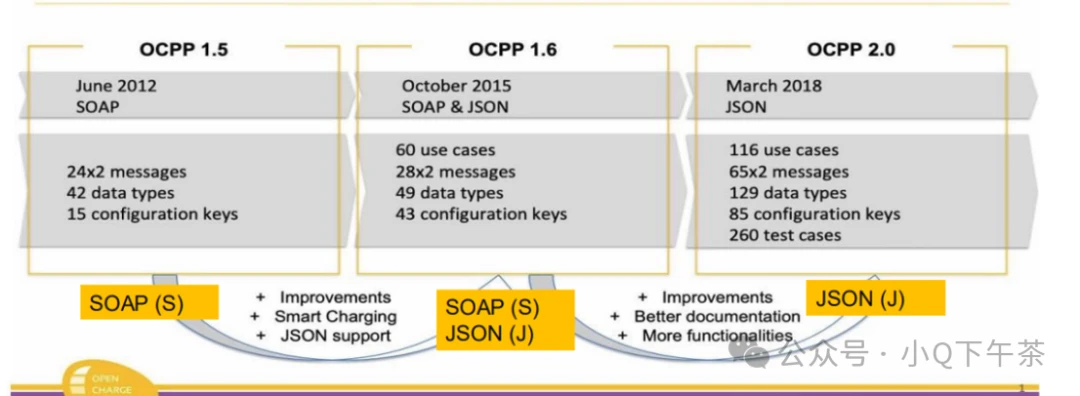
(1)OCPP1.2(SOAP)
(2)OCPP1.5(SOAP)
Due to the existence of numerous proprietary protocols within the industry, which hinder unified service experience and interoperability between different operators, the Open Charge Alliance (OCA) took the lead in developing the open protocol OCPP 1.5. SOAP, constrained by its protocol limitations, could not be rapidly promoted on a large scale. OCPP 1.5 communicates with central systems using the SOAP protocol based on the HTTP protocol, enabling the operation of charging points. It supports functionalities such as local and remote transaction initiation, including metering for billing.
OCPP 1.6 (SOAP/JSON) introduced JSON format implementation alongside SOAP, enhancing the extensibility for smart charging. The JSON version communicates via WebSocket, allowing data exchange in any network environment. The most widely used version in the market is the 1.6J version, supporting JSON format data over WebSocket to reduce data traffic and enabling operation on networks without support for packet routing (e.g., public internet). Smart charging functionalities include load balancing, central and local intelligence, and retransmission of point information (based on current charging point information), such as the final metering value or charging point status.
OCPP 2.0 (JSON), released in 2018, improved transaction processing, enhanced security, and introduced device management functionalities. It expanded smart charging capabilities for energy management systems (EMS), local controllers, and topologies for electric vehicle integration with smart charging, charging stations, and management systems. OCPP 2.0 also supports ISO 15118 for plug-and-play and smart charging requirements for electric vehicles.
OCPP 2.0.1 (JSON) is the latest version, released in 2020. It provides new features and improvements, such as ISO 15118 support for plug-and-play, enhanced security, and comprehensive performance enhancements.
C.OCPP Version Compatibility
OCPP 1.x is backward compatible. OCPP 1.6 is compatible with OCPP 1.5, and OCPP 1.5 is compatible with OCPP 1.2.
OCPP 2.0.1 is not compatible with OCPP 1.6. While some content in OCPP 2.0.1 may exist in OCPP 1.6, the format of the transmitted data frames is completely different.
2.The OCPP 2.0.1 Protocol
A.Compared to earlier versions like OCPP 1.6, OCPP 2.0.1 brings significant improvements in several aspects:
Enhanced Security: OCPP 2.0.1 reinforces security by introducing HTTPS connections based on the Secure Socket Layer (SSL) and a new certificate management scheme to ensure secure communication.
Addition of New Features: OCPP 2.0.1 introduces many new features, including intelligent charging management and more detailed fault reporting and analysis.
More Flexible Design: The design of OCPP 2.0.1 is more flexible, catering to complex and diverse application requirements.
Simplified Code: OCPP 2.0.1 simplifies the code, making software implementation easier.
In OCPP 2.0.1, firmware updates include digital signatures to prevent incomplete firmware downloads, thus avoiding firmware update failures.
In practical applications, the OCPP 2.0.1 protocol can be used for remote control of charging stations, real-time monitoring of charging status, user authentication, and other functions, significantly improving the efficiency and security of charging equipment. OCPP 2.0.1 offers more details and features compared to version 1.6, albeit with increased development complexity.
B.Introduction to OCPP 2.0.1 Features
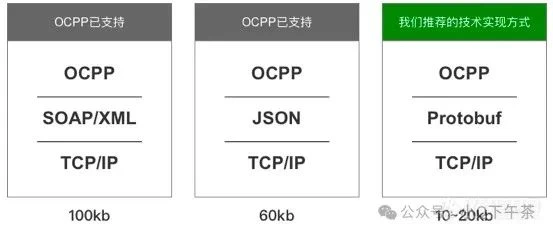
OCPP 2.0.1 Protocol is the latest version of the OCPP protocol, which has made significant improvements and optimizations compared to OCPP 1.6. The main enhancements include:
Message Transmission: OCPP 2.0.1 introduces new message types and modifies some old message formats to improve efficiency and performance.
Digital Certificates: OCPP 2.0.1 introduces a security mechanism based on digital certificates, providing strengthened device authentication and message integrity protection. This is a significant improvement over the security mechanism in OCPP 1.6.
Data Model: OCPP 2.0.1 updates the data model, adding support for new device types and functionalities.
Device Management: OCPP 2.0.1 provides more comprehensive device management functions, including device configuration, fault diagnosis, software updates, etc.
Component Model: OCPP 2.0.1 introduces a more flexible component model, which can be used to describe more complex charging devices and systems. This helps in implementing advanced functionalities such as Vehicle to Grid (V2G).
Smart Charging: OCPP 2.0.1 adds support for smart charging, allowing dynamic adjustment of charging power based on grid conditions or user demands.
User Identity and Authorization: OCPP 2.0.1 provides a more comprehensive user identity recognition and authorization mechanism, supporting multiple user authentication methods, and imposes higher requirements on user data protection.
3.Introduction to OCPP Functionality
A.Smart Charging
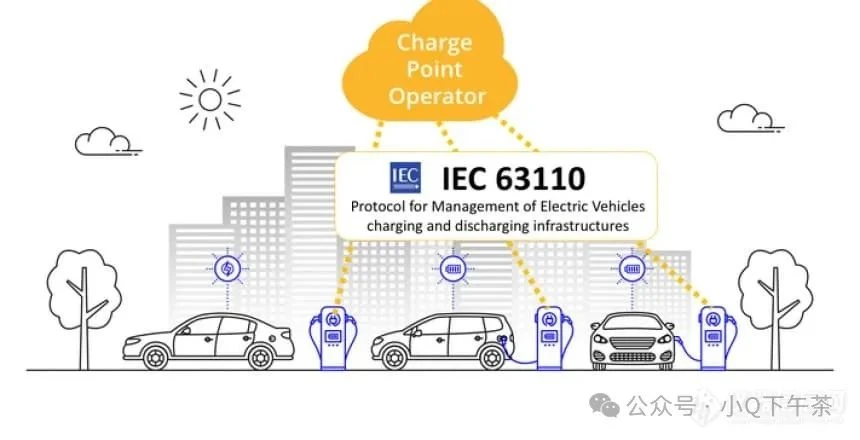
The External Energy Management System (EMS) and OCPP 2.0.1 are designed to address the issue of external constraints on Charging Station Management Systems (CSMS). The notification mechanism introduced in OCPP 2.0.1 informs the CSMS of any external limitations. Direct smart charging inputs from an EMS can handle various scenarios, such as:
Electric vehicles (EVs) connected to charging points via ISO 15118
OCPP 2.0.1 supports ISO 15118, an updated protocol for EVSE to EV communication. The plug-and-charge and smart charging features of the ISO 15118 standard, including inputs from EVs, are easier to implement with OCPP 2.0.1. This allows charging station operators to send messages about the charging station from the CSMS to display to EV drivers.
Smart charging purposes include:
Load Balancing Load balancing primarily addresses the internal load of a charging station. The station controls the charging power of each charging pile according to pre-configured settings. A fixed limit value, such as the maximum output current, is set for the station. Additionally, the configuration includes optional options to optimize power distribution across charging piles. This configuration indicates that charging rates below this value are ineffective and other charging strategies should be chosen.
Central Smart Charging Central smart charging assumes that charging limits are controlled by a central system. After receiving predictions about grid capacity from the grid operator, the central system calculates part or all of the charging plans. It imposes charging restrictions on charging piles by responding to messages to set these limits.
Local Smart Charging Local smart charging is implemented through a local controller, which acts as an OCPP protocol proxy. It receives messages from the central system and controls the charging behavior of other stations in the group. The local controller can be equipped with charging piles or choose not to be. In local smart charging mode, the local controller imposes limits on the charging power of the station. These limits can be modified during the charging process, and the group's limit values can be configured locally or by the central system.
B:System Introduction
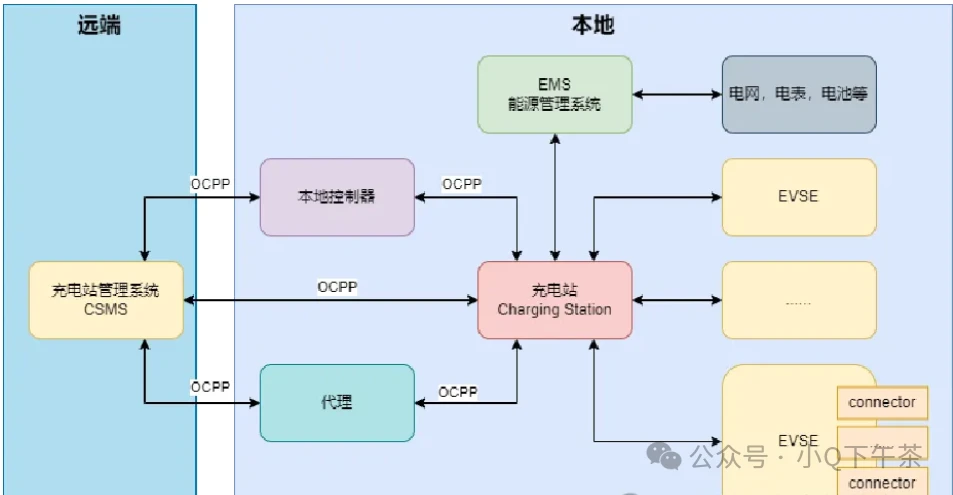
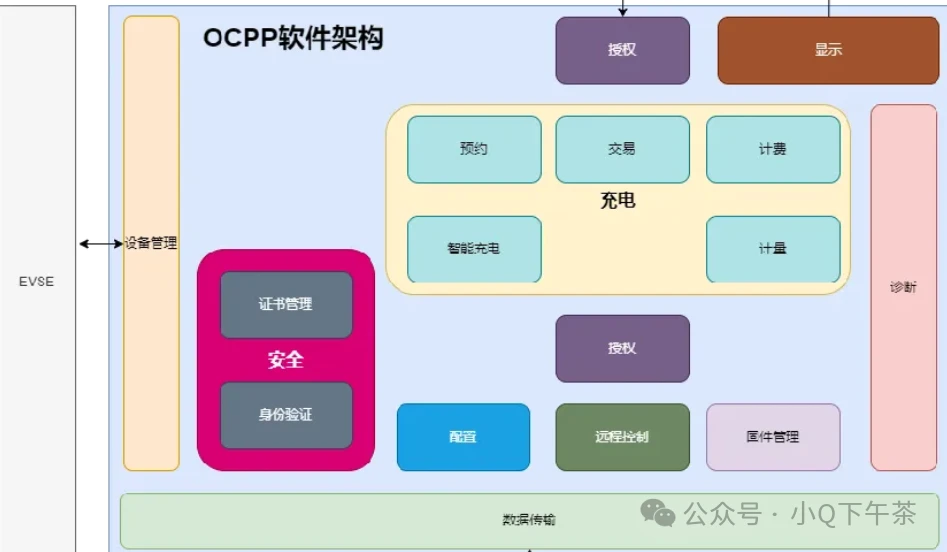
The functional modules in the OCPP2.0.1 protocol mainly include:
Data Transfer Module
Authorization Module
Security Module
Transactions Module
Metering Module
Cost Module
Reservation Module
Smart Charging Module
Diagnostics Module
Firmware Management Module
Display Message Module
4.OCPP future development
A.OCPP Advantages The Open Charge Point Protocol (OCPP) is a free and open protocol, serving as an effective solution for the interoperability of charging stations. It has been promoted and used in many countries around the world. Although China has not yet formed a unified protocol, using OCPP as a basis could facilitate communication between operators' services in the future. With the development of China's new energy vehicle industry, the adjustment and unification of charging facilities are imminent. Whether national departments or operators will adopt the OCPP protocol still requires time to be tested.
Before the advent of OCPP, each charging pile manufacturer developed their own proprietary protocol for backend connections, locking charging pile operators with individual manufacturers. Now, as almost all hardware manufacturers support OCPP, charging pile operators are free to choose hardware from any supplier, making the market more competitive.
The same applies to property/business owners; when they purchase non-OCPP charging stations or sign contracts with non-OCPP CPOs, they are locked into specific charging stations and operators. However, with OCPP-compliant charging hardware, owners can remain independent of suppliers. They can freely choose CPOs that are more competitive, cost-effective, or feature-rich. They can also expand their network by mixing different charging pile hardware without having to remove existing devices.
A major benefit for electric vehicle drivers is that they do not need to rely on a single charging pile operator or EV supplier. Similar to purchasing OCPP charging stations, EV drivers can switch to better CPOs/EMPs. A second, but very important benefit is the ability to use e-mobility roaming. OCPP and another open protocol, OCPI, make e-roaming possible. E-Roaming provides EV drivers with access to all available charging infrastructure with just one subscription or contract with an E-Mobility service provider.
B.Differences Between OCPP and Domestic Protocols Currently, most domestic charging equipment manufacturers and operators, such as State Grid, Southern Power Grid, Teld, and Aulton, adopt the 104 protocol as the base protocol and modify it to some extent.
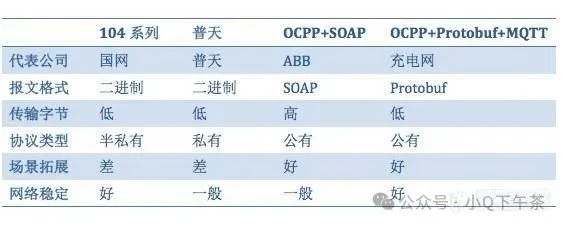
The 104 protocol, based on TCP/IP, is a binary communication protocol known for its small data size but poor readability and lack of extensibility. Its disadvantages include the management of user account information and reservations, vehicle-side BMS information and battery authentication, and real-time status information of parking spaces. For example, it would be difficult for a time-sharing rental company to optimize user experience deeply through the charging pile's transmission of relevant information; similarly, it's challenging for charging piles to promptly inform car owners about battery status due to weak extensibility.
Therefore, due to these disadvantages, some manufacturers have made certain modifications during implementation to partially meet the above-mentioned unfulfilled scenarios. This has led to variations in the details of each manufacturer's implementation, essentially making it a semi-private protocol when interfacing externally, resulting in significant customized integration costs.
It is reported that the 104 protocol includes two parts: business data format and network management. Currently, most manufacturers do not use the related commands for network management during implementation. Previously, as most dedicated fast-operational charging stations were built in urban areas and on the ground, wireless connection issues were not severe. However, with the development of private passenger cars and the construction of charging facilities based on parking lot renovations, the complexity of charging locations can lead to unreliable connections. In such cases, the lack of a method to handle weak network signals has revealed numerous problems.
C.The role of OCPP in electric vehicle charging includes:
OCPP facilitates communication between EVSE (Electric Vehicle Supply Equipment) and CSMS (Charging Station Management System).
Authorization for electric vehicle users to start charging.
Remote modification of charging configurations, remote charging control (start/stop), and remote unlocking of the charging gun (connector ID).
Real-time status of the charging station (available, stopped, suspended, unauthorized EV/EVSE), real-time charging data, real-time power consumption, and real-time EVSE faults.
Smart charging to reduce the load on the electrical grid.
Firmware management (Over-The-Air Authorization).
These functions help improve the efficiency and user experience of electric vehicle charging infrastructure.