

With the popularity of electric vehicles, charging technology has become one of the core elements to promote the development of electric transportation. Among them, CCS (Combined Charging System) charging standard, as a global charging standard, is widely used in the fast charging system of electric vehicles in the European and American markets. As Chinese companies gradually enter the European and American markets, CCS charging standard has gradually attracted the attention of more engineers.
This article will discuss the basic principles, characteristics and related consistency test standards of CCS charging standard in an easy-to-understand way.
The development history and interface design of CCS charging standard:
The history of CCS charging standard can be traced back to 2011. At that time, different charging standards appeared in the electric vehicle markets in Europe, North America and Asia, which brought problems of interoperability and charging convenience to the development of electric vehicles worldwide. To solve this problem, the European Automobile Manufacturers Association (ACEA) proposed the CCS charging standard proposal, which aims to integrate AC and DC charging into a unified system. The physical interface of the connector is designed as a combined socket with integrated AC and DC interfaces, which can be compatible with 3 charging modes: single-phase AC charging, three-phase AC charging and DC charging. It can provide more flexible charging options for electric vehicles. The CCS Combo 1.0 standard was officially released in 2012.
In 2014, CCS Combo 2.0 was released, which is an important upgrade to the previous version, further improving the charging power and supporting faster DC charging. This version of the CCS standard has also been widely adopted in the European and North American markets. Since then, the CCS standard has been iterated twice (CCS Combo 2.0.1 and CCS Combo 2.0.2) in 2017 and 2020, further improving the charging power and improving safety.

For historical reasons, CCS includes two physical plug designs. The left side of the above picture is the CCS Type 2 plug (CCS2 for short), which is mainly used in the European market. The right side is the CCS Type 1 (CCS1 for short), which is mainly used in the North American market, including the United States and Canada. The first letter C in CCS stands for Combined. It is called "combined" because the charging port integrates the AC part (upper part) and the DC part (lower part). Only the upper part of the interface is used during AC charging, and the lower DC interface is used for energy transmission during DC charging, and some pins of the upper plug are used for communication. It is worth mentioning that, unlike the CAN communication used in the national standard DC charging, the communication between the electric vehicle (EV) and the charging pile (EVSE) in CCS AC and DC charging is achieved through the Control Pilot (CP) interface. The pins related to charging control are:
CP - Control Pilot:
Transmits PWM signals for AC charging control and modulation signals based on power line communication (PLC) for establishing high-level communication in AC or DC charging.
PP - Proximity Pilot:
There is a preset resistor between this pin and PE, which allows the EV to recognize that the charging gun head is connected and the maximum current carrying capacity of the cable.
PE - Protective Earth:
It is used for EV grounding protection and also serves as the reference ground for CP and PP.
International standards related to CCS:
The standards related to charging are large and complex. Due to space limitations, this article will briefly explain several standards closely related to CCS AC and DC charging.
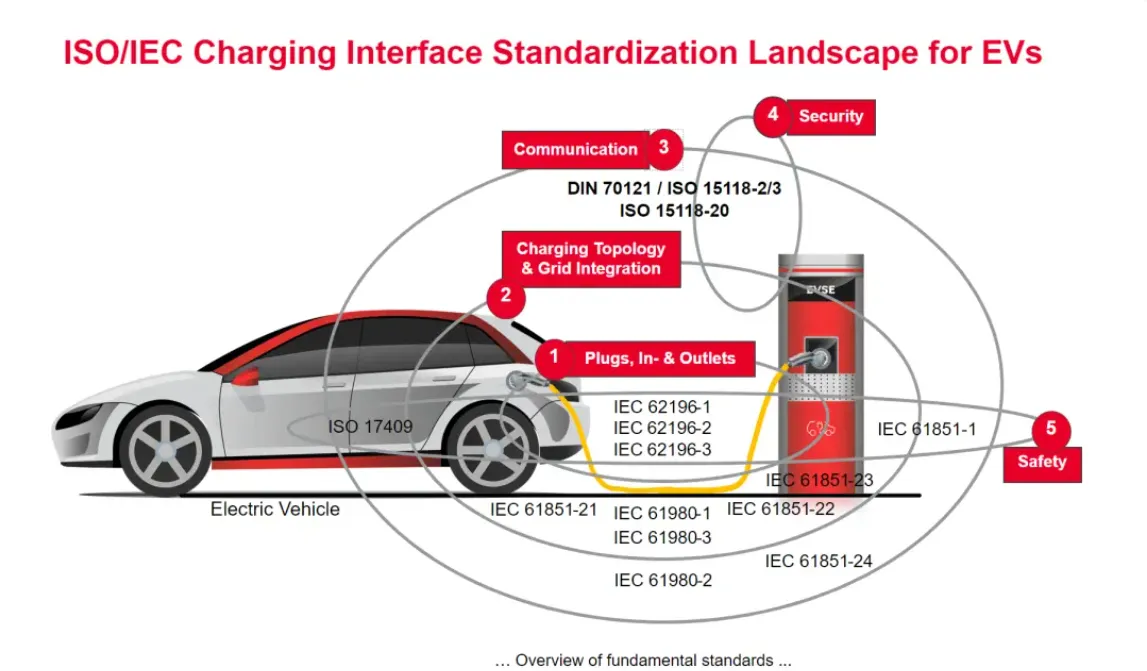
IEC 61851-1
The IEC 61851 series of standards is the earliest international charging system standard developed by the IEC organization, and can be called the cornerstone of charging standards. It has important reference significance for the formulation of charging system standards in other countries or the formulation of subsequent charging standards such as DIN70121 or ISO15118.
IEC61851-1 stipulates the general requirements of the charging system, especially the specifications of AC charging. Including my country's AC charging standard GB/T18487.1-2015, it also draws on the same control guidance method.

In simple terms, AC charging control guidance is to achieve the change of detection point voltage on the CP line by connecting the charging gun head and controlling the opening and closing of the S2 switch on the vehicle end, so as to realize the recognition and switching of the charging state between the vehicle and the pile. In addition, the charging pile informs the vehicle of the maximum current that can be provided by generating PWM signals with different duty cycles.
Since the actual charging strategy during AC charging is implemented by the on-board charger OBC. Therefore, the requirements for information interaction between the vehicle and the pile can be met only by the change of detection point voltage and duty cycle. When it comes to DC charging, due to the obvious increase in the demand for information interaction between the vehicle and the pile, simple analog signals can no longer meet the needs. Therefore, IEC 61851-1 defines in mode 4 that high-level communication (HLC) is achieved through the CP line to transmit the DC charging protocol defined in IEC 61851-23.
The high-level digital communication of CCS adopts power line communication (PLC) based on HomePlug GreenPHY as the data link layer protocol. In simple terms, the OFDM modulated high-frequency signal is coupled to the CP signal line through a modem installed on the CP signal circuit of the charging pile or vehicle, and demodulated by the modem at the other end. This enables a communication rate of up to 10 Mbit/s without adding additional communication pins, providing a high-bandwidth information interaction channel for DC charging information interaction and advanced functions such as plug-and-play charging and even vehicle-grid interaction.
BPT (V2G) will be the focus of the future development of the charging market in Europe and the United States. Due to the characteristics of the energy structure in Europe and the United States, distributed energy (DER) has become a widely accepted and recognized development direction. As a naturally high-quality energy storage medium, EV batteries must participate in the regulation of smart grids. The release of the existing new standards has only technically removed the obstacles from the car to the charging pile, but from the pile to the operating platform to the power distributor, there are still many problems of inconsistent standards.
In addition, due to the communication characteristics of CCS, based on the existing technology, not only can bidirectional power transmission of DC be realized, but AC V2G can also be realized. Therefore, consistency testing related to AC grid connection may also become a focus of future new energy vehicle R&D personnel.